Falling Mortgage Rates: Your Smartest Time to Buy a Home is Now
For the past three years, the American Dream has felt stuck behind a paywall.
If you are like many of the clients we work with at My Home Pathway, you have done the hard work. You earn a solid income. You pay your bills. You dream of a backyard or an extra bedroom. But between rising inflation, skyrocketing home prices, and punishing interest rates, the math just hasn't worked.
For first-time buyers especially, mortgage rates hovering above 7% didn't just make homes expensive—they made them impossible. A "Risk Challenged" profile (perhaps a credit score that isn't quite 740, or a debt load that is a little heavy) combined with high rates meant instant rejection.
But the tide has finally turned.
As of this week, the financial environment has shifted, and momentum is swinging back toward everyday buyers. The Federal Reserve has signaled a new era, mortgage rates are cooling, and for the first time in a long time, the door to homeownership is cracking open.
If you have been waiting on the sidelines, feeling judged by your credit score or discouraged by the market, this guide is for you. We are going to break down exactly what happened yesterday in Washington, what it means for your wallet, and how you can use Risk Transformation to seize this window before it closes.
The Big Shift: What Just Happened?
To understand why this moment is unique, we have to look at the macro picture.
On December 10, 2025, the Federal Reserve made a pivotal move that economists have been waiting for: they lowered the benchmark interest rate for the third consecutive time this year. This brings the target range down to 3.50%–3.75%.
Why This Matters to You
The Federal Reserve doesn't set mortgage rates directly, but they set the "weather" for the economy. When the Fed cuts rates, they are telling banks: "It is safe to lend money again."
For the past two years, the Fed was hiking rates to fight inflation. That battle is largely won. Now, they are cutting rates to stimulate growth. This signals a policy shift from "Caution" to "Confidence."
The Result: Banks pay less to borrow money.
The Trickle Down: Those savings are passed on to you in the form of lower interest rates for credit cards, auto loans, and most importantly, mortgages.
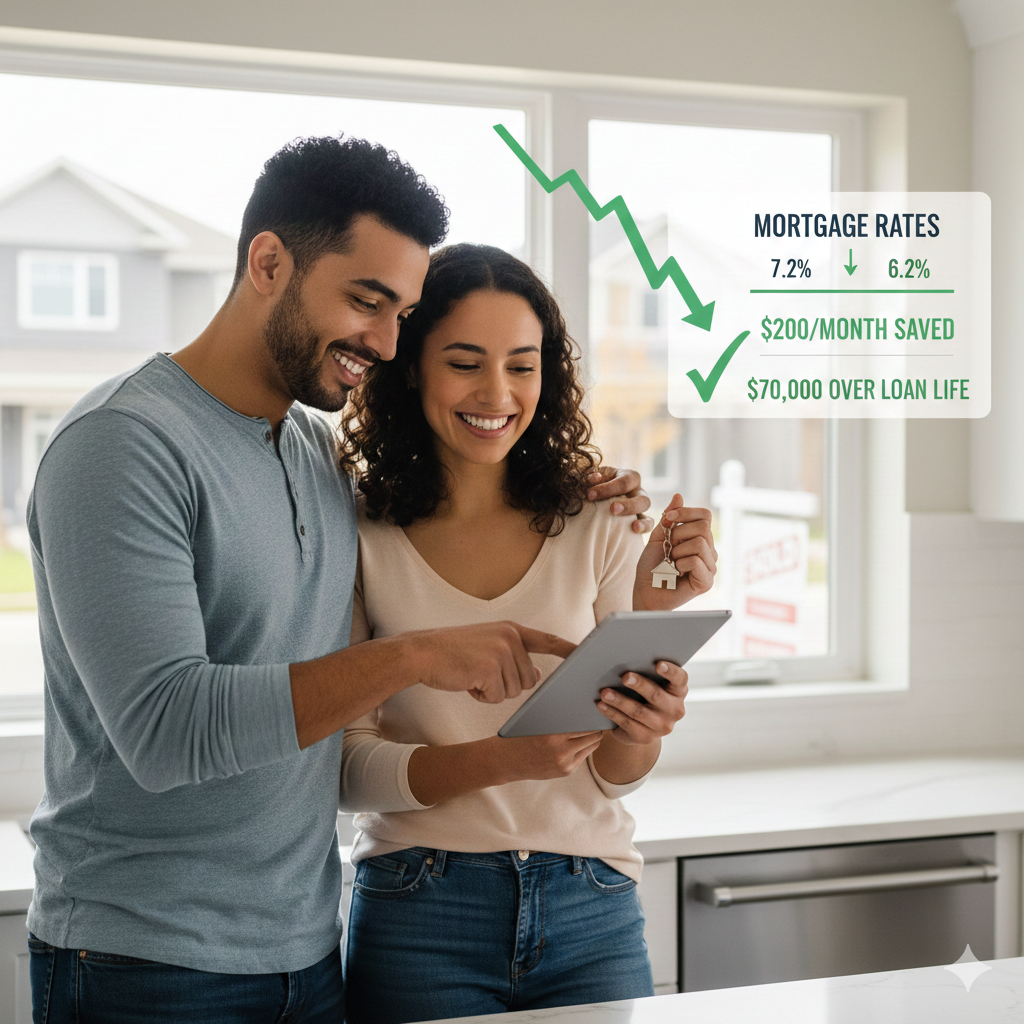
As of December 2025, the average 30-year fixed mortgage rate has eased to approximately 6.2%. This is a significant drop from the peaks above 7% seen throughout 2023 and early 2024. While 6.2% might not sound historically low compared to 2020, in the context of the current economy, it is a game-changer.
The Mathematics of Affordability: The "Power of 1%"
It is easy to glaze over when talking about percentages. Does a 1% drop really matter?
Yes. It matters more than the purchase price.
When interest rates drop, your "Buying Power" increases. This means you can buy the same house for less money per month, or a better house for the same money.
Let’s look at the real numbers for a typical family looking at a $300,000 mortgage:
Scenario A: The "Old Market" (7.2% Rate)
Loan Amount: $300,000
Interest Rate: 7.2%
Monthly Principal & Interest: $2,037
Total Interest Paid Over 30 Years: $433,000
Scenario B: The "New Market" (6.2% Rate)
Loan Amount: $300,000
Interest Rate: 6.2%
Monthly Principal & Interest: $1,837
Total Interest Paid Over 30 Years: $361,000
The Savings Breakdown
Monthly Savings: $200
Yearly Savings: $2,400
Lifetime Savings: $72,000
Think about what $200 a month means. That is your electric bill. That is a week of groceries. That is your car insurance. By simply entering the market now versus six months ago, you are effectively giving yourself a $2,400 annual raise.
The Hidden Benefit: Fixing Your DTI Ratio
Here is the secret that lenders rarely explain clearly. Falling rates don't just save you money; they help you qualify.
Lenders use a metric called Debt-to-Income Ratio (DTI) to decide if you are "risky." They look at your monthly gross income versus your monthly debt obligations. Most lenders cap this at 43%–50%.
If you earn $5,000 a month, a lender might say you can only spend $2,150 on a mortgage (including taxes and insurance).
At 7.2%, that $300k home payment might push you over the limit, resulting in a Denial.
At 6.2%, that same home payment drops, potentially sliding you under the limit, resulting in an Approval.
Key Takeaway: If you were rejected for a mortgage in 2024 because your "DTI was too high," you might be approved today without changing a single thing about your income, simply because the rate drop lowered the monthly obligation.
The "Secret Menu": Below-Market Rates & Community Programs
While national news focuses on the "Average Rate" (that 6.2% figure), smart buyers know that the average is just a baseline. The real opportunity lies in the Specialized Mortgage Market.
This is where My Home Pathway provides a unique advantage.
Because affordability is a national concern, many organizations—including local housing finance agencies, community banks, and nonprofits—are offering below-market interest rates to stimulate homeownership in specific communities.
How Low Can They Go?
We have seen partner programs offering rates significantly lower than the national average. In some recent cases, buyers in specific regions (often prioritized for community development) secured mortgages with interest rates around 3% to 4.5%.
These aren't "too good to be true" scams; they are subsidized programs designed to help working families build wealth.
Why haven't you heard of them?
Big banks don't advertise them (they make less profit on them).
They are often local or state-specific.
They have specific eligibility requirements (income limits, first-time buyer status, etc.).
My Home Pathway bridges this gap. Our platform connects you to a national directory of these "hidden" lenders and programs. We don't just tell you the national rate; we help you find your best rate.
The Down Payment Myth: You Don't Need $50k Cash
Even with falling rates, the biggest psychological barrier remains the down payment.
If you are renting, saving $20,000 for a down payment while paying $2,500 in rent feels like trying to fill a bucket with a hole in the bottom. This is where the concept of Risk Transformation meets tactical financial aid.
The Power of Down Payment Assistance (DPA)
DPA programs are grants or low-interest loans provided by state and local governments to help cover your down payment and closing costs.
Grants: Money you never have to pay back.
Forgivable Loans: Loans that disappear if you live in the house for a set number of years (usually 5–10).
Soft Seconds: Loans with 0% interest that you only pay back when you sell the house or refinance.
The Multiplier Effect
Imagine combining today's lower interest rates with a $15,000 DPA grant.
Rate Drop: Saves you $200/month.
DPA Grant: Keeps $15,000 in your emergency fund (or pays your closing costs).
Result: You enter homeownership with a manageable payment and your savings intact.
Through My Home Pathway, you can instantly see which of these programs match your profile. You don't need to be a detective; you just need the right app.
Why Waiting for "Perfect" is a Trap
We often hear clients say, "I'll wait until rates drop to 4%."
We understand the logic. But in the housing market, waiting comes with a hidden tax.
The Supply and Demand Seesaw
When rates drop, more buyers enter the market.
When more buyers enter the market, competition increases.
When competition increases, home prices go up.
If you wait for rates to drop another 1%, home prices might rise by 5% or 10% due to bidding wars. You might get a lower interest rate, but you will be paying it on a much more expensive house, wiping out your savings.
The "Sweet Spot" Strategy
The current moment—December 2025—is a sweet spot.
Rates have fallen enough to be affordable.
BUT, the "buying frenzy" hasn't fully restarted yet.
Sellers are still willing to negotiate (unlike in 2021).
By acting now, you lock in a decent rate (which you can refinance later if they drop further) while securing a home price before the spring market competition drives values up. As the old real estate saying goes: "Date the rate, marry the house."
How to Start Your Risk Transformation Today
If you earn over $50,000 but have felt "locked out" due to credit or risk profile issues, here is your 3-step action plan to capitalize on the December 2025 market shift.
Step 1: The Digital Audit
Don't guess at your credit score. Lenders use different models than the free credit apps you might have on your phone.
Action: Download the My Home Pathway app. Sync your accounts to see exactly what an underwriter sees.
Goal: Identify "Ghost Risk"—small things like unused credit cards or old disputes that are dragging your score down.
Step 2: The "Clean 90"
Lenders love consistency. Now that rates are down, you want to present a stable profile.
Action: For the next 90 days, ensure no overdrafts, no new credit applications (don't open that store card for 10% off!), and maintain a positive balance.
Goal: Create a 3-month "paper trail" of financial reliability. This is often enough to override a shaky history from a year ago.
Step 3: The Program Match
Stop applying blindly to big banks. It hurts your score and leads to discouragement.
Action: Use the My Home Pathway directory to find lenders who specifically work with DPA programs and "Risk Challenged" borrowers.
Goal: Apply once, to the right partner, who understands your story and has access to below-market rates.
Conclusion: Your Window is Open
The headlines are clear: The Fed is cutting. Rates are falling. The economy is shifting.
But headlines don't buy houses—action does.
For years, the market headwinds were blowing against you. Now, for the first time in a long time, the wind is at your back. You have the income. You have the desire. And now, the market is offering you the opportunity.
Don't let the fear of your past financial mistakes dictate your future. Your credit score is not a character judgment; it is simply data. And data can be improved.
The Bottom Line:
Rates are down (~6.2%).
The Fed is supportive.
Specialized programs exist to lower your costs further.
If you are ready to turn renting into ownership, now is your moment. Stop watching the market and start preparing your profile.
Ready to see if you qualify for below-market rates and down payment assistance?
👉 Create your free My Home Pathway account today at www.myhomepathway.com and take the first step toward your future home.